
A Season’s Gamble: How a Chef and a Gambler Weigh Risk
This article is a comparative analysis of risk management in professional cooking and professional gambling. It does not promote, endorse, or link to any real-money gambling operators. All gambling references are used as metaphors for decision-making under uncertainty.
The kitchen and the casino floor might seem like opposite ends of the human experience – one rooted in nourishment and creation, the other in chance and anticipation. But beneath the surface, both worlds are governed by the same relentless pressure: the need to make critical decisions with incomplete information. As supply chains tremble and the climate shifts, the modern Canadian chef has more in common with a professional gambler than either might care to admit. Both must master the art of the calculated risk.
The Art of the Calculated Risk
For a chef, a menu is not just a list of dishes; it is a strategic portfolio of risks. Every ingredient selected, every dish priced, and every season anticipated is a bet placed on an uncertain future. The primary gamble begins with the agricultural calendar.
A chef planning a September menu is betting that the local apple harvest will be abundant and that the heirloom tomatoes will ripen perfectly. They are wagering that the spot prawn season will be long and that supply chains will hold. As of 2024, the stakes are higher than ever, with 62% of Canadian restaurants operating at a loss or barely breaking even. In January of that year alone, restaurant insolvencies in Canada rose 112% year-over-year, reaching the highest monthly count in over a decade.
How Chefs and Gamblers Face the Same Uncertainty
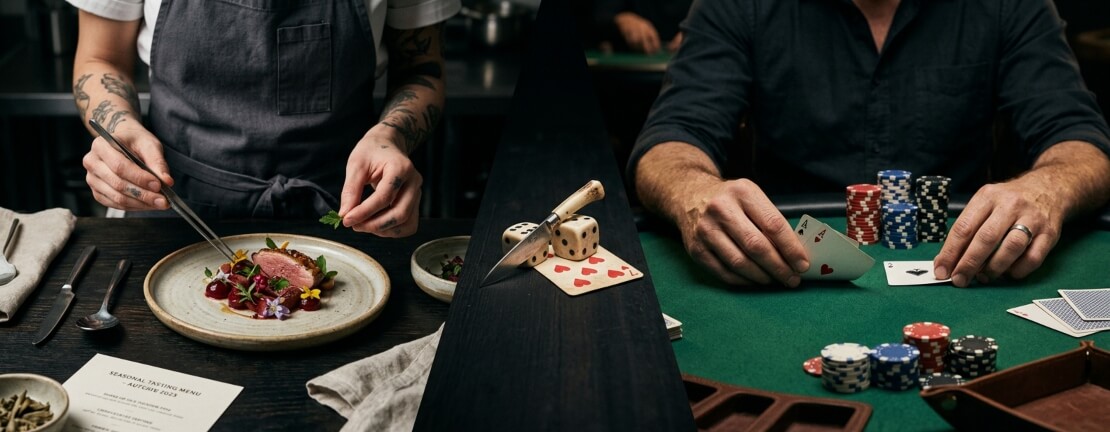
Factor | The Chef’s Bet | The Gambler’s Bet |
|---|---|---|
Timing | Menu depends on harvest calendar (apples in Sept, tomatoes in Aug) | Hand depends on deck composition and position at the table |
Information available | Weather forecasts, supplier reliability, past yields | Odds, pot odds, opponent tendencies (in poker) |
Typical loss rate | 62% of restaurants operate at a loss (2024 data) | House edge in roulette: 2.7%-5.26%; poker: depends on skill |
“Bad beat” example | A late frost destroys the peach crop two days before a tasting menu | You go all‑in with Aces and lose to a river flush |
A professional gambler operates under a similar principle: they do not bet on a feeling; they bet on a calculated probability. “If you’re not prepared to take risks playing poker, you cannot make money,” explains Caspar Berry, a former professional poker player and risk expert. This mirrors the reality of the restaurant industry. A chef who refuses to adapt to seasonal shifts or inflation will not survive.
However, both also know that the “fold” is often the smartest move. In poker, folding is a proactive decision to cut losses. In a kitchen, this is equivalent to the difficult decision to take a dish off the menu or substitute a key ingredient when quality fails. The true cost of risk isn’t in the loss itself, but in failing to recognize when the odds are no longer in your favour.
The Key Risks Facing Chefs and Gamblers
Both professions face a unique set of unpredictable variables that can spell disaster or create opportunity. For the chef, risks are often tangible and rooted in the physical world; for the gambler, they are mathematical and psychological.
For a Chef (The Restaurant Business):
- Supply Chain Volatility: A 2022 Restaurants Canada report found that supply chain disruptions have affected 96 per cent of restaurateurs.
- Weather & Climate: A single degree of frost can decimate a fruit crop. In 2025, Ontario farmers faced a season marked by “weather extremes and mounting economic uncertainty,” with some areas seeing “complete crop loss” due to drought.
- Labour & Costs: Since 2022, food costs in Ontario are up 24%, labour costs up 18%, and insurance costs up 24%.
- Consumer Trends: A shift in behaviour means dining out is often one of the first expenses cut by households facing record debt levels.
For a Gambler (The Risk Environment):
- Variance & “The Bad Beat”: The statistical probability of losing a hand even when you are statistically favoured to victory.
- Bankroll Management: The risk of ruin by betting too high a percentage of your funds on a single outcome.
- Emotional Tilt: The psychological state of making irrational bets after a loss, often leading to disaster.
- Game Integrity: The risk of fraud, software glitches, or simply the “house edge” that ensures long-term statistical loss.
Tools of the Trade: Mitigating the Unknown
Neither a chef nor a gambler walks into the arena blindly. Both have developed sophisticated toolkits to manage the chaos. By comparing these tools, we can see a clear framework for risk management.
Tool / Strategy | The Chef’s Application | The Gambler’s Application |
|---|---|---|
The Hedge | Maintaining relationships with multiple local farms to ensure supply if one fails. | Using hedging strategies in betting exchanges to guarantee a profit regardless of an event’s outcome. |
The Kelly Criterion | Deciding how much of a profit margin to allocate to expensive, high-risk ingredients versus reliable staples. | A formula used by investors and gamblers to determine the optimal size of a series of bets to maximize long-term growth. |
Risk Management Programs (BRM) | Utilizing federal programs like AgriStability or Production Insurance to protect against crop failure or income decline due to weather. | Setting strict loss limits and stop-losses. Walking away after losing a predetermined amount is the ultimate insurance policy. |
Data Analytics | Using inventory management software to track waste, predict demand, and adjust portion sizes in real-time. | Studying poker solvers, RTP (Return to Player) statistics, and historical game data to find an “edge” over the house or other players. |
“Poker inculcates a very pro-risk mindset for a very simple reason, which is that if you’re not prepared to take risks playing poker, you cannot make money.” – Caspar Berry, Former Professional Poker Player
“Creativity has to be about doing something you don’t know how to do… I don’t care about failure and I’m not afraid to fail.” – Alex Stupak, Chef of Empellón
The Psychology of a Bet: Managing Emotion
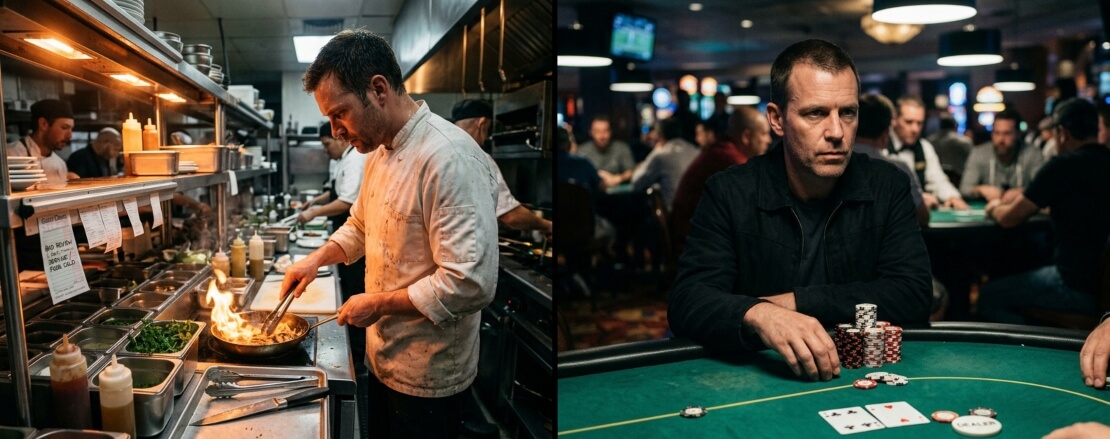
Perhaps the most powerful link between the kitchen and the casino is the psychological toll of constant decision-making. When the stakes are high – whether it’s a restaurant’s monthly rent or a player’s bankroll – emotion becomes the enemy of logic.
In poker, “tilt” is the state of mental or emotional confusion that leads a player to make aggressive, irrational plays. In a restaurant, this happens during a dinner rush when a chef receives a bad review or discovers a missing delivery. The pressure to “get back” losses leads to rash decisions.
This is why both professions value discipline. A professional gambler “plays cold, calculated and unemotional,” understanding the odds of every play. Similarly, a seasoned chef follows “mise en place” – a disciplined system of organization that ensures that when the heat is on, they can rely on their preparation rather than their impulses.
In a world of “black swan” events – unforeseen incidents that shatter expectations – the ability to separate the outcome from the decision is critical. A chef can make a perfect menu plan, and a gambler can make a perfect statistical bet, and both can still lose. The measure of a professional is not avoiding failure, but how quickly they recalculate the odds for the next round.
Five Rules for Taking a Calculated Risk
Whether you are plating a dish or placing a bet, the fundamentals of risk assessment remain the same.
- Define the Downside. Before asking “how much can I get?”, ask “how much am I willing to lose?” If the loss would cripple your business or your bankroll, the risk is too high.
- Trust the Data, Not the Gut. Emotion distorts probability. Rely on historical data, market trends (for chefs), and statistical models (for gamblers) rather than intuition.
- Manage the Bankroll. Never put all your capital into a single seasonal menu or a single hand of cards. Diversification and patience are the keys to survival.
- Learn to Fold. The most successful decision is often the decision to not play. Knowing when to cut your losses – whether by substituting an expensive ingredient or walking away from a bad beat – is a sign of strength, not weakness.
- Prepare for the Black Swan. Assume that something will go wrong. Build redundancy into your supply chain or set aside a contingency fund for variance. As Caspar Berry notes, you must prepare for the unpredictable.
We live in an era of profound uncertainty. From the rising costs of goods to the volatility of global markets, the ability to assess risk has become a universal life skill. The professional chef and the professional gambler operate as the canaries in the coal mine for the rest of us. They navigate the razor’s edge of uncertainty every day, using a blend of discipline, data, and courage.
By studying their methods – by learning to hedge bets, manage bankrolls, and accept the math of probability – we can all learn to navigate the gambles of our own lives with a little more skill and a little less fear. The next time you sit down for a farm-to-table meal, remember: the journey of that ingredient to your plate was a gamble that paid off.